Capybara Pattern Garden Cottagecore: A Designer's Whimsical Asset
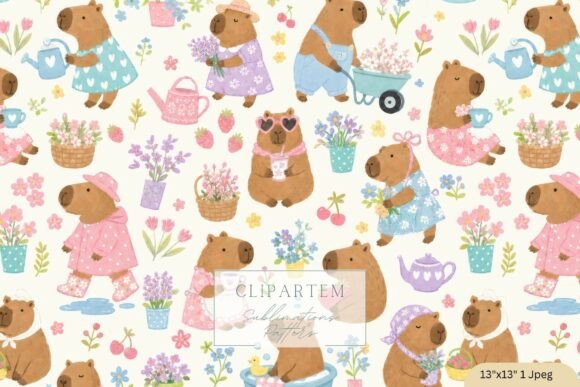
Finding a surface pattern that balances genuine whimsy with professional execution is a rare discovery. The Capybara Pattern Garden Cottagecore design achieves this balance by blending the internet's favorite rodent with the timeless, comforting aesthetic of cottagecore. It’s a seamless tile that doesn’t just decorate a surface; it tells a gentle story. Imagine capybaras, not just lounging, but actively tending to a garden, dressed in sweet, pastoral outfits with watering cans and baskets of blooms. This narrative quality is what makes the pattern so compelling for a wide range of creative applications.
What truly defines its visual personality is the considered palette. Set against a soft cream background, the combination of dusty rose, lavender, sage green, and sky blue creates an atmosphere that is instantly warm and nostalgic. This isn't a loud, primary-colored children's print; it’s a sophisticated, muted color story that appeals to adults while retaining an irresistibly cute charm. The inclusion of tiny rubber ducks by the bath adds a layer of playful detail that rewards closer inspection, making the pattern feel alive and full of character. For designers and creators, this means having a premium design asset that carries emotional weight and visual depth right out of the file.
Strategic Applications: Beyond Simple Fabric
While its heart lies in textile design, the utility of the Capybara Pattern Garden Cottagecore extends far into branding, packaging, and digital media. Its seamless tile format and high-resolution 300 DPI file make it ready for almost any production workflow. For entrepreneurs and small business owners, particularly those in the baby, pet, or lifestyle niches, this pattern can become a cornerstone of a brand identity. It works beautifully for nursery wallpaper, creating an immersive environment, or as the main print for children's fabric yardage and quilting projects, where its repeating nature ensures continuous visual flow.
In the realm of print-on-demand (POD) merchandise, its versatility is a significant strength. Consider its application on:
- Tote bags and pouches: The pattern creates an eye-catching accessory that feels artisanal and unique.
- Kawaii stationery and notebooks: It transforms everyday items into collectible pieces, perfect for a creative font pairing on covers.
- Packaging design: For a small-batch soap company or a tea brand, using this pattern as box liner or label background infuses the product with warmth and storytelling.
- Social media graphics: A cropped section can serve as a distinctive background for quotes, promotions, or Instagram stories, enhancing visual consistency across platforms.
The key is to view it not as a single-use illustration, but as a foundational design asset that can be cropped, scaled, and recolored to fit specific project needs while maintaining its core charm.
Integrating the Pattern into Professional Workflows
Adopting a pattern like this into a professional toolkit requires a bit of strategic thinking. First, always evaluate the project's tone. The Capybara Pattern Garden Cottagecore excels in contexts aiming for friendliness, nostalgia, and gentle whimsy. It may not suit a corporate fintech report, but it’s perfect for a bakery's branding, a children's book interior, or a podcast cover for a cozy, narrative-driven show. Its strength lies in creating an emotional connection, so pair it with complementary typography. A clean sans serif font for body text can provide excellent readability against the detailed pattern, while a handwritten font or script font for headlines can amplify its personal, crafted feel.
When testing font pairings, consider visual hierarchy. The pattern itself is rich with detail, so text placed over it needs to stand out. Use solid color blocks, subtle overlays, or generous whitespace to create separation. Think about the commercial licensing included with the file—understanding the terms is crucial for any commercial font or asset. Since this is a seamless JPEG, it's ready for direct upload to platforms like Spoonflower, Printify, or Printful, streamlining the production process for print-on-demand creators.
Ultimately, the value of a resource like the Capybara Pattern Garden Cottagecore pattern is in its ability to inject personality and cohesion into a project. It’s more than a cute image; it’s a versatile tool for building a recognizable aesthetic. For the designer juggling client work, the crafter building an Etsy shop, or the content creator developing a cohesive visual brand, this pattern offers a ready-made solution that feels both professionally crafted and deeply personal. It proves that in the world of surface design, the most powerful assets are often those that tell a small, delightful story.